You're Not Behind on AI. You're Right on Time.
Highlights: Feeling behind on AI adoption? Stop. Early adopters faced an 85% project failure rate and watched their investments become obsolete overnight. AI Overviews wiped out years of SEO work (even HubSpot lost 70-80% of traffic). Late adopters now skip expensive mistakes, start with proven tools, and implement AI-native strategies while competitors untangle costly legacy systems. The window is closing, but you're positioned to leapfrog, not catch up.
Why being late to AI adoption is your competitive advantage:
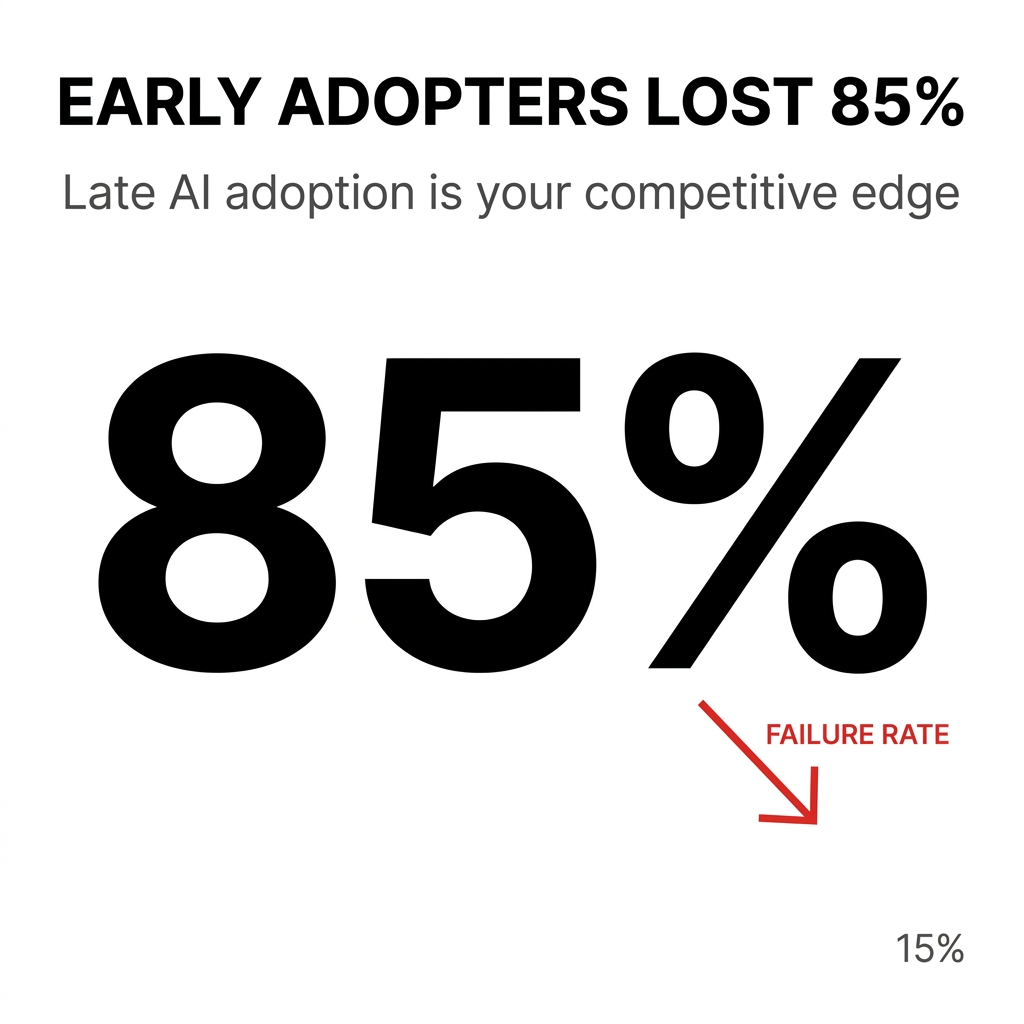
85% of early AI projects failed due to immature technology and unclear ROI
AI search fundamentally changed the game in 2024-2025, making early SEO investments obsolete
Late adopters start with stable, proven tools instead of becoming unpaid beta testers
You skip the Frankenstack problem that now costs companies millions to untangle
Follow a clear sequential stack (LLMs → agents → multi-agents → custom tools) instead of guessing
I talk to professionals every week who feel guilty about their AI adoption timeline.
They see the headlines. They hear the hype. They watch competitors announce AI initiatives. They feel behind.
Here's what I've learned after watching this space closely: being late to AI adoption is the smartest strategic position you hold right now.
What Is the Early Adopter Tax?
We know about the waiting tax. Wait too long, and you pay in lost opportunity and competitive disadvantage.
But there's another cost nobody talks about: the early adopter tax.
Early adopters pay a premium for being first. They absorb troubleshooting costs, build workflows around tools that no longer exist, and become unpaid beta testers for immature technology.
Gartner research confirms 85% of AI projects fail to deliver on their promises. Poor data quality, inadequate risk controls, escalating costs, and unclear business value cause abandonment after proof of concept.
McKinsey found only 7% of respondents indicated AI had been fully scaled across their organizations as of 2025. While 88% of organizations now use AI in at least one business function, most remain stuck in experimentation or pilot phases.
More telling: only 39% of respondents reported any impact on enterprise-wide EBIT from AI. Most impacts were less than 5%.
Early adopters burned budgets on solutions that didn't deliver.
Bottom line: The 85% failure rate and minimal ROI prove first movers paid a massive premium for unproven technology. Late adopters skip this entire costly phase.
What Are Frankenstacks and Why Do They Matter?
Early digital transformation adopters created what industry experts call "Frankenstacks." These are complex, layered systems that combine new technology with legacy code.
They layered new technology on top of legacy systems and built custom software modern developers struggle to decipher. Companies like Wells Fargo, Generali, and ManuLife now use software intelligence technology to untangle the complex applications they built as first movers.
Being first meant building on unstable ground. The tools evolved faster than implementations.
Many original AI tools are now irrelevant. Workflows built around them became technical debt.
The insight: First movers created expensive technical debt trying to integrate immature technology. Late adopters build on stable foundations instead of untangling million-dollar messes.
How Did AI Search Change SEO Overnight?
A year ago, we lacked the ability to quickly utilize AI for inbound visibility through AI search.
The landscape has fundamentally shifted. AI Overviews now appear in approximately 48% of all tracked queries as of February 2026. That's up from 31% in February 2025, a 58% increase year over year.
Education queries went from 18% to 83%. B2B Tech climbed from 36% to 82%.
When AI Overviews are present, organic click-through rate plummeted 61% (from 1.76% to 0.61%). Paid CTR crashed 68% (from 19.7% to 6.34%).
HubSpot, with one of the best SEO teams in the world, experienced 70-80% organic traffic decline. Their monthly organic visits plummeted from approximately 13.5 million in November 2024 to less than 7 million by December 2024.
The scale sent shockwaves through the content marketing industry because "If HubSpot, with one of the best SEO teams in the world, experiences this, none of us are safe."
CNN suffered traffic declines between 27-38% year-over-year. Forbes and HuffPost both recorded 50% traffic losses. The median publisher experienced a 10% year-over-year traffic decline in the first half of 2025.
Companies that spent years building traditional SEO strategies now face a complete strategic pivot. They're stuck with legacy approaches while the game has changed.
What this means for you: Early SEO investments were wiped out overnight. Late adopters start with AI-native strategies instead of pivoting from obsolete playbooks.
How Can Late Adopters Leapfrog Competitors?
If you're starting now, you start with proven tools. The experimentation phase is over.
You avoid the costly mistakes early adopters made. You implement AI-native SEO strategies before competitors who are stuck with legacy approaches.
The people who went before you narrowed the focus and learned what not to do. That's a huge advantage.
You build on stable ground instead of shifting sand. Research shows companies that integrated AI within comprehensive ecosystems achieve 3.5x greater ROI than those deploying AI in isolation.
Late adopters now start with proven, stable tools instead of the immature technology that plagued early projects.
Your advantage: You skip the 85% failure rate, avoid Frankenstacks, start with AI-native approaches, and learn from documented mistakes. All while competitors untangle their costly messes.
Where Should You Start? The Sequential AI Stack
Most people I talk to feel overwhelmed by AI. They don't understand where to start.
The solution is understanding the sequential stack of AI tools. Here's the progression:
Step 1: Start with LLMs (Large Language Models)
These are your foundation. Learn how to use ChatGPT, Claude, or similar tools effectively. Master prompting and understand how to get quality outputs.
Step 2: Move to Agents
These are AI tools that take actions on your behalf. They automate workflows and handle repetitive tasks.
Step 3: Explore Multi-Agents
These are systems where multiple AI agents work together to solve complex problems.
Step 4: Build Custom Tools
Build or implement solutions tailored to your specific needs.
By identifying where you are in this progression, you remove the overwhelm. You start with the next easiest step to get the most time and efficiency back from AI tools.
Why this works: Sequential adoption eliminates overwhelm, builds competency systematically, and ensures each step delivers measurable efficiency gains before moving forward.
Why Timing Still Matters: The Window Is Closing
I'm not saying you should wait forever. Timing still matters.
Right now, you're competing with people who know how to use and deploy AI. That's manageable because you learn, catch up, and leapfrog with better strategy.
But with the advancement of agentic tools like OpenAI's new releases and independent agents, the window is closing.
The longer you wait, the more likely you are to be competing with machines themselves instead of people using machines.
There's a critical difference between being strategically late and being dangerously behind.
The reality: You're currently in the optimal window. Wait too long, and you'll compete against autonomous AI agents instead of people using AI tools.
Why Is AI Different From Other Technologies?
In most cases, you pay a waiting tax because anything that becomes a marketplace change carries a huge price for late adoption.
But AI is different. The technology advanced so quickly that early investments became obsolete before delivering returns.
The tools matured. Strategies clarified. Mistakes got documented.
You're not behind. You're positioned to move faster than early adopters who are now stuck untangling their Frankenstacks and pivoting away from legacy SEO strategies that no longer work.
You start with AI-native approaches. You implement proven tools. You avoid the 85% failure rate that plagued early projects.
The difference: AI evolved faster than any previous technology. Therefore, first movers paid for obsolescence while late movers benefit from stability.
The guilt you feel about being late is misplaced. You're not late. You're right on time.
What Should You Do Next?
Stop feeling guilty about your timeline. Guilt wastes energy you need for implementation.
Start by assessing where you are in the AI adoption stack:
Are you comfortable with LLMs?
Have you explored agents?
Do you understand AI search visibility?
Pick one area. Master it. Move to the next.
The early adopters paid the tuition. You get to benefit from their expensive education.
That's not being behind. That's being smart.
Ready to Start Your AI-Native Strategy?
You've seen the data. Early adopters paid the 85% failure tax. Traditional SEO got wiped out overnight. The window for strategic advantage is closing.
The question isn't whether to adopt AI. It's whether you'll leapfrog competitors or get left behind.
First Step: Audit Your AI Search Visibility
Before you build an AI strategy, you need to know where you stand. AI Overviews now dominate 48% of searches. Are you visible in them, or are you invisible to the new search behavior?
Get your free AI Search audit at audit.aitwinbrain.com
You'll discover:
How your website performs in AI search results
Where you're losing visibility to AI Overviews
Specific opportunities to optimize for LLM citability
Your AI search readiness score
Next Step: Build Your AI-Native Content Strategy
Once you know where you stand, you need a strategy built for AI search from the ground up. Not a pivot from legacy SEO. Not a Frankenstack layered on old approaches.
A clean, proven, AI-native system.
That's where AI TwinBrain comes in. We help late adopters turn their timing into a competitive advantage by implementing strategies early adopters wish they had started with.
Explore AI-native strategies at aitwinbrain.com
You're not behind. You're positioned to move faster than competitors stuck untangling their mistakes.
But only if you start now.
Frequently Asked Questions
Is it too late to start with AI in 2026?
No. You're in an advantageous position because you start with proven tools and avoid the 85% failure rate early adopters experienced. The window is closing as agentic AI advances, so starting soon is critical.
What is the early adopter tax in AI?
The early adopter tax is the premium first movers paid for immature technology. This includes an 85% project failure rate, wasted budgets on obsolete tools, and technical debt from Frankenstacks that now require specialized tools to untangle.
How did AI Overviews impact traditional SEO?
AI Overviews appear in 48% of Google searches and reduced click-through rates by 61%. Elite SEO operations like HubSpot experienced 70-80% organic traffic declines, effectively wiping out years of traditional SEO investment overnight.
What's the difference between being strategically late and dangerously behind?
Being strategically late means starting now with proven tools while competitors untangle legacy systems. Being dangerously behind means waiting until you're competing against autonomous AI agents instead of people using AI tools.
Where should I start with AI adoption?
Start with LLMs (Large Language Models) like ChatGPT or Claude. Master prompting and quality outputs first, then progress to agents, multi-agents, and finally custom tools. This sequential approach eliminates overwhelm.
What are Frankenstacks?
Frankenstacks are complex systems created by early adopters who layered new AI technology on top of legacy code. Companies like Wells Fargo and Generali now need specialized software intelligence technology to decode and untangle these systems.
How can late adopters leapfrog early adopters?
Late adopters skip the experimentation phase and its 85% failure rate. They implement AI-native SEO strategies, start with stable tools, and avoid expensive mistakes while early adopters are stuck pivoting from obsolete approaches.
Will AI search replace traditional SEO completely?
AI search is rapidly overtaking traditional SEO. With 60% of Google searches now ending without any click and AI Overviews dominating 48% of searches, traditional SEO alone will make you invisible by late 2026.
Key Takeaways
Early AI adoption carried an 85% failure rate. Late adopters avoid this costly experimentation phase and start with proven, stable tools instead of immature technology.
AI Overviews captured 48% of Google searches, reducing click-through rates by 61% and causing traffic declines of 70-80% for elite SEO teams like HubSpot.
Traditional SEO investments became obsolete overnight, creating a strategic pivot requirement that traps early adopters while late adopters start with AI-native approaches.
Follow the sequential AI stack: start with LLMs, progress to agents, then multi-agents, then custom tools to eliminate overwhelm and maximize efficiency.
The window for strategic late adoption is closing. You're competing with people using AI now, but soon you'll compete against autonomous AI agents themselves.
Being late is only advantageous if you act now. You leapfrog competitors stuck with Frankenstacks and legacy systems, but only if you start implementing proven AI strategies today.