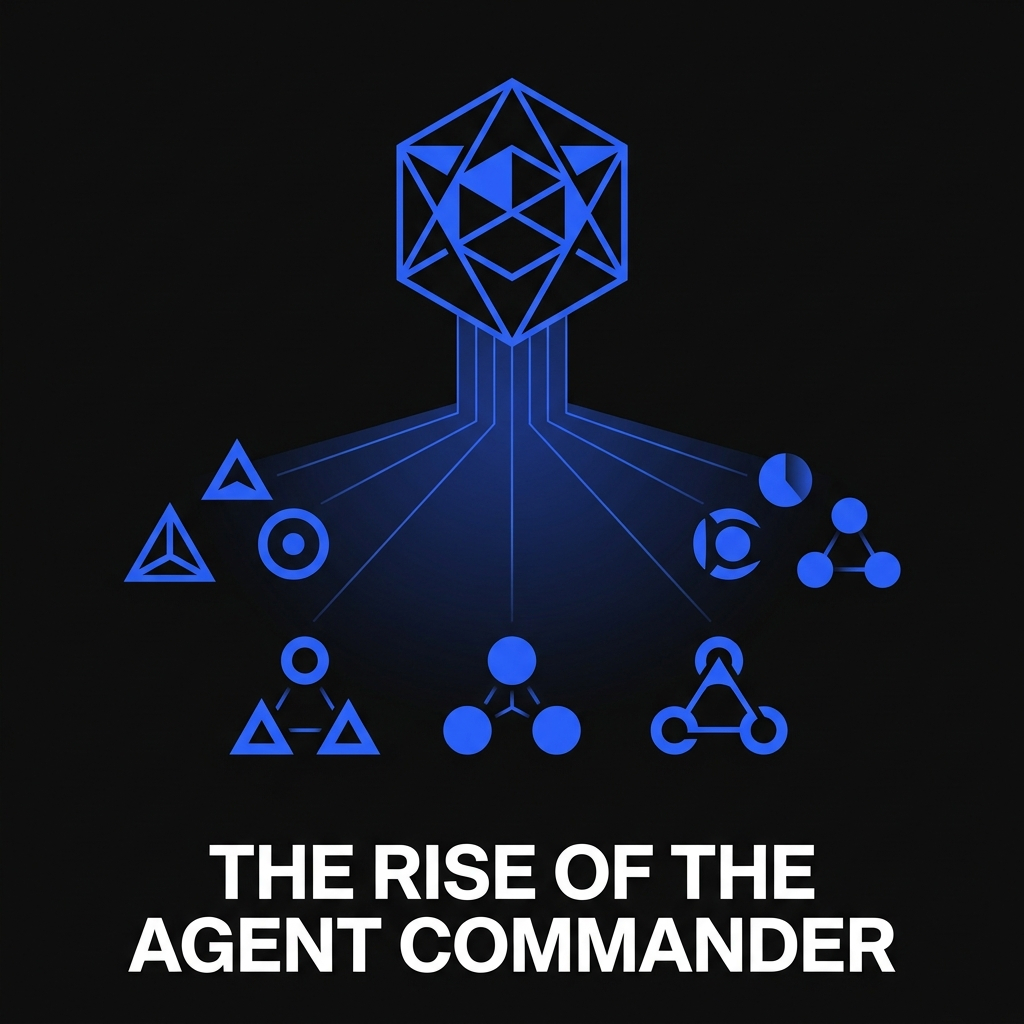
The Rise of the Agent Commander: Why the Next Class of Entrepreneurs Won't Run Companies, They'll Run Agent Teams
An Agent Commander is an entrepreneur who directs a Super Agent that coordinates a team of specialized AI agents, rather than executing work personally.
They sit at the top of a hierarchy of intelligence and command it. It's the same chain-of-command pattern that has run every effective organization in human history, now finally available to a solopreneur.
This is not theory. The infrastructure is here:
Gartner projects that 40% of enterprise applications will be integrated with task-specific AI agents by the end of 2026, up from less than 5% in 2025 (Gartner, August 2025).
Anthropic's June 2025 multi-agent research showed that an orchestrated team of agents outperformed a single-agent system by 90.2% on complex research tasks (Anthropic, 2025).
McKinsey estimates that generative AI combined with adjacent technologies has the technical potential to automate work activities that absorb 60 to 70% of employees' time today (McKinsey, 2023).
The only thing in short supply is the operator identity that knows how to use it.
The stake of this essay is simple: in eighteen months, the entrepreneurs who win will not be the ones working hardest. They will be the ones commanding teams of agents while the rest of the market is still asking which prompt to copy.
Why the Old Operator Model Just Broke
At 2am last Tuesday, I checked my phone one last time before sleep. Three deliverables had shipped while I was on a dinner call.
A research brief I'd asked for that morning was sitting in my inbox, footnoted and ready. A campaign sequence I hadn't even briefed yet had been drafted, because the system saw the gap and filled it.
Somewhere out there, a different kind of operator was scrolling. Refreshing dashboards. Drafting their own emails. Triaging their own inbox. Telling themselves they were "grinding."
They weren't grinding. They were falling behind.
Not because they weren't working hard. They were working harder than me.
That's the part nobody wants to say out loud. The operators who are about to win aren't winning because of effort. They're winning because they made one decision the rest of the market hasn't made yet.
They stopped trying to be the doer.
You Are Not Behind on AI. You Are Behind on Becoming the Kind of Operator AI Rewards.
Read that twice.
Ninety-nine percent of the AI conversation right now is about tools. Which prompt to use. Which model is best. Which workflow to copy. Which Chrome extension to install this week.
It's the wrong conversation.
It's the conversation a 1995 executive was having about email versus fax. Useful at the surface. Catastrophic if it's the whole frame.
The real shift isn't about using AI. Anyone can use AI. My mom uses AI.
The shift is about a new identity that AI makes possible for the first time in history, and the small number of people who are going to claim it before the rest of the market catches on.
I call them Agent Commanders.
An Agent Commander does not use AI. They command it. They don't open ChatGPT to write a post. They wake up to a morning brief from a Super Agent that has already coordinated nine specialists overnight and is now asking for three approvals before deploying the day's work.
That's not a productivity hack. That's a different operating system for being an entrepreneur.
What Does an Agent Commander's Day Actually Look Like?
Let me make this concrete, because the theory is cheap and the texture is what matters.
I wake up. Coffee. Phone.
The Super Agent's morning brief is already there, organized the way I trained it to organize: what shipped overnight, what's blocked, what needs my judgment today, what opportunities surfaced from the research the scout agent ran while I was asleep.
I read for nine minutes. I approve three decisions.
One of them is a pricing test the analyst agent flagged after watching engagement patterns for the last 72 hours. I redirect one initiative because the angle the strategist drafted is good but not the angle I want to plant a flag on. I add one note to the knowledge base about a story I want woven into next quarter's content.
That's the morning. Maybe twenty minutes.
The Super Agent goes back to work. It briefs the creator agent. It hands research to the scout. It queues the analyst to track results. It pings me only when something is above its decision threshold, which I set, and which gets sharper every week as it learns what I actually care about.
By lunch, four pieces of content are in review. By dinner, two are live, one is scheduled, one is back in the queue with notes.
The system did the work. I did the directing.
This isn't science fiction. This is happening in my business right now. The architecture exists.
What's missing for most operators isn't the tools. It's the identity to use them this way.
Why Does Hierarchy Beat Swarm?
Most AI products are making the same category error.
They are either selling chatbots, which are toys, or selling single-agent assistants, which are training wheels, or selling swarms, which are chaos dressed up as innovation.
None of those map onto how effective teams actually function in the real world.
Every productive organization in human history has been hierarchical with delegation. A general doesn't issue orders to every soldier. A CEO doesn't write every line of code. A surgeon doesn't sterilize their own instruments.
The pattern works because it concentrates judgment at the top and execution at the bottom, with a clear chain of command in between.
That's why I built the Super Agent System the way I did. One Super Agent in command. Nine specialists below: strategist, scout, analyst, creator, and the rest of the team that runs an authority engine. Infinite sub-agents on demand, each with the specific skill the work requires.
It's not a swarm. Swarms don't ship.
It's not a chatbot. Chatbots don't think.
It's a chain of command, finally available to a solopreneur.
The data backs this architecture, hard. Anthropic's multi-agent research system, published in June 2025, used Claude Opus 4 as a lead agent coordinating Claude Sonnet 4 subagents in parallel, and outperformed a single-agent Claude Opus 4 baseline by 90.2% on internal research evaluations (Anthropic, 2025).
Read those numbers again. Then ask yourself what you are optimizing for if you are still using AI like it's a search engine with better manners.
What Identity Shifts Make an Agent Commander?
This is the part most people skip and then wonder why the tools aren't working for them.
The tools are working fine. The identity is the bottleneck.
There are three shifts, in order:
1. From doer to director.
The doer's reflex is to grab the task. The director's reflex is to delegate it.
This sounds simple. It is brutal in practice.
Every founder I know has muscle memory built from years of being the one who does the work. Letting that go feels like losing competence. It is not. It is gaining leverage.
The cost of this shift is your identity as the person who works hardest in the room. What you unlock is the ability to be in ten rooms at once.
2. From manager to strategist.
A manager spends their time keeping things on track. A strategist spends their time deciding which tracks are worth being on.
When the Super Agent and its team are handling execution, your job is no longer to make sure the work gets done. Your job is to decide what work matters.
This shift costs you the small dopamine hit of crossing things off a list. What you unlock is the bandwidth to think about positioning, market timing, and the moves that compound over years instead of hours.
3. From operator to architect.
This is the deepest shift and the one almost no one talks about.
An operator runs the business. An architect designs the system the business runs on.
Once you have a Super Agent and a team beneath it, your real work becomes the design of that system: what it learns, how it learns, where it makes decisions on your behalf, where it asks for yours.
You stop being the engine. You become the person who builds engines.
The cost is the comfort of feeling busy. What you unlock is a business that grows when you sleep.
The Line in the Sand
Here is the part I am willing to say out loud that most people in this space are not.
In eighteen months, the question is not going to be do you use AI. Everyone will use AI. That's a settled question, like asking in 2010 if you use email.
The question is going to be: how many agents report to you?
If the answer is zero, you do not have a business. You have a hobby with a logo.
If the answer is one or two, you are early but you are moving.
If the answer is a Super Agent commanding a coordinated team, with sub-agents spinning up on demand and a chain of command that mirrors how every effective organization in history has been built, you are the new class of operator the market is about to reward.
I am not saying this to be provocative. I am saying it because I have built it, I am running it, and I can already feel the gap widening between people who have made this shift and people who are still asking which prompt to use.
The shift is not technological. The technology is here. The shift is identity.
You stop being the founder who does the work. You stop being the solopreneur who wears every hat. You stop being the manager trying to keep up with the inbox.
You become a commander.
You sit at the top of a system you designed. You make the decisions only you can make. You let everything else go to the team you built, the team that does not sleep, does not complain, does not quit, and gets sharper every week you train it.
The On-Ramp
I built AI Twin Brain's Super Agent System because I needed it before it existed.
One Super Agent in command. Nine specialists ready to run your authority engine. Infinite sub-agents on demand for any skill the work requires. The chain of command that makes you a commander instead of a doer.
If you are an operator who has been feeling the ground shift under your feet, this is the on-ramp. Not a chatbot. Not another assistant. The system that turns you into the kind of operator the next eighteen months are going to reward.
See the full Super Agent System and how the nine specialists work together at aitwinbrain.com.
You are not behind on AI. You are behind on becoming the kind of operator AI rewards.
That changes today, or it doesn't. The choice is identity, not effort.
If you want to see exactly where your business is leaking leverage before you build anything, run the free 5-minute AI Readiness Audit at audit.aitwinbrain.com. It will show you which of the three identity shifts is currently capping your growth, and which agent role you should deploy first.
Frequently Asked Questions
What is an Agent Commander?
An Agent Commander is an entrepreneur who directs a Super Agent that coordinates a team of specialized AI agents, rather than executing work personally. The role replaces the "doer" model of solo operation with a directing-and-delegating model that scales without headcount. The Agent Commander makes the decisions only a human owner can make and delegates everything else to the system. AI Twin Brain's Super Agent System is the on-ramp into this role.
How is a Super Agent different from a chatbot?
A chatbot responds to one prompt at a time. A Super Agent commands a team of nine specialized agents and infinite sub-agents, orchestrating multi-step work across content, research, distribution, and analytics in parallel. The architectural difference is hierarchy and delegation, the same pattern that makes human organizations function. Anthropic's June 2025 research showed multi-agent systems outperforming single-agent setups by 90.2% on complex tasks (Anthropic, 2025).
What does AI Twin Brain's Super Agent System actually do?
AI Twin Brain's Super Agent System places one Super Agent in command of nine specialist agents (strategist, scout, analyst, creator, and the rest of an authority engine) and spins up infinite sub-agents on demand for any specific skill the work requires. The Super Agent receives your direction, briefs each specialist, coordinates handoffs, surfaces decisions only you can make, and ships finished work end to end. See the full architecture at aitwinbrain.com.
Do I need technical skills to deploy an agent team?
No. The Super Agent System is built for operators and founders, not engineers. The interface is conversational. You direct the Super Agent in natural language, set your decision thresholds, and approve work as it surfaces. The technical orchestration, agent coordination, and sub-agent spin-up happen underneath, the same way you do not need to be a mechanic to drive a car. Run the readiness audit at audit.aitwinbrain.com to see your starting point.
How long until an agent team produces results?
Useful output appears in the first week as the Super Agent learns your voice, your positioning, and your decision thresholds. Compounding leverage (where the system gets sharper than you would on the same task) typically lands in 30 to 60 days, depending on how much you train it through approvals and corrections. The bottleneck is almost never the technology. It is how quickly the operator makes the identity shifts from doer to director to architect.
Is AI going to replace solopreneurs and entrepreneurs?
No. AI is going to replace the solopreneur who insists on staying the doer. The solopreneur who becomes an Agent Commander will out-ship, out-position, and out-earn ten doer-solopreneurs combined, because they are operating at a different layer of leverage. Gartner projects 40% of enterprise applications will embed task-specific agents by the end of 2026 (Gartner, August 2025); the operators who direct that infrastructure win, the ones who race it lose.
What is the difference between an Agent Commander and a CEO?
A traditional CEO directs humans. An Agent Commander directs a Super Agent that directs a team of AI agents. The decision-making layer is identical (vision, positioning, market timing, capital allocation), but the execution layer no longer requires hiring, payroll, management overhead, or human time zones. The Agent Commander captures most of the leverage a 50-person company would deliver, with the speed and margin of a solo operator.