The AI Productivity Paradox: Why Companies Save Time But Not Money
TL;DR: AI tools save digital workers 11 hours per week, but they spend 6.5 of those hours managing the AI itself—providing context, checking outputs, and correcting errors. This productivity paradox explains why individual efficiency surges while company performance stays flat. Tata Consultancy Services plans to reach a one-to-one ratio of AI agents to human employees within three years, signaling a structural shift in hiring and workforce composition across industries.
Core Insights
Digital workers save approximately 11 hours weekly using AI, but spend 6.5 hours managing AI tasks (context provision, output validation, error correction).
TCS projects a 1:1 ratio of AI agents to human employees within three years, with AI-related revenue reaching $2.5 billion annually.
AI is creating a new job category focused on AI literacy, prompt engineering, output validation, and ethical governance.
Successful AI adoption requires deep workflow integration, comprehensive training, shadow AI management, and embedded governance.
The shift from traditional hiring patterns is structural, not cyclical—growth no longer automatically translates into proportional headcount increases.
I've been tracking the AI transformation in corporate America for the past year, and something strange is happening.
Companies are adopting AI tools at record speed. Workers report massive time savings. Yet organizational performance barely budges.
The numbers tell a weird story.
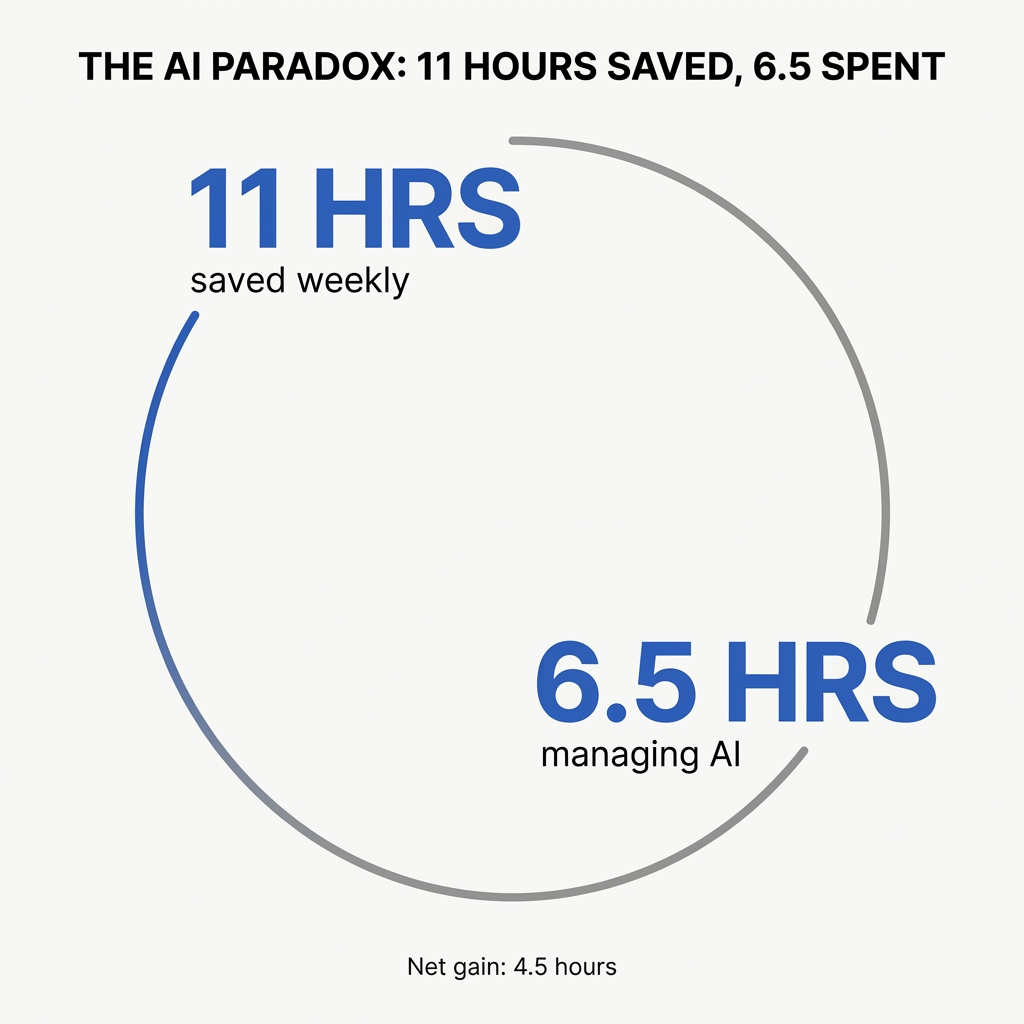
According to the Glean Work AI Index, digital workers save about 11 hours per week using AI tools. That's more than a full workday returned to each employee.
But here's the catch: they spend 6.5 of those hours managing the AI itself.
That's the paradox. Individual productivity skyrockets, yet company performance stays flat because the management overhead consumes most of the time saved.
What Is the Hidden Cost of AI Adoption?
When TCS chairman N Chandrasekaran announced the company would slow its hiring pace, he wasn't talking about a temporary adjustment. He was describing a structural shift in how work gets done.
TCS plans to reach a one-to-one ratio of AI agents to human employees within three years. Not as a supplement. As actual workforce composition.
No planned downsizing, Chandrasekaran clarified. Just different math going forward.
The company projects AI-related revenue will hit an annualized $2.5 billion. That's not a side project. That's a business line.
But the announcement came right after TCS reduced its headcount. The timing raised questions about what "no planned downsizing" actually means when you're replacing hiring with algorithms.
Key Point: TCS's shift to a 1:1 AI-to-human ratio represents a structural change in workforce planning, not a temporary adjustment—companies will scale through AI rather than proportional hiring.
How Do Employees Actually Spend Time Managing AI?
The 6.5 hours workers spend managing AI breaks down into three main activities:
Providing context. AI tools need constant feeding. You explain the project background, the company terminology, the specific outcome you want. Every single time.
Checking outputs. You review what the AI generated. You compare it against requirements. You verify it makes sense in your specific situation.
Correcting errors. You fix the hallucinations, the misunderstandings, the confidently wrong answers that sound plausible but miss the mark.
This isn't busywork. It's the actual labor of human-AI collaboration.
The 11 hours saved? That's real. AI handles repetitive tasks, first drafts, data processing, and routine analysis faster than humans.
The 6.5 hours spent? Also real. Someone has to be the adult in the room.
Key Point: Human-AI collaboration requires constant context provision, output validation, and error correction—this management overhead is the actual labor cost of AI adoption.
Why Is AI Management Becoming a Job Category?
I'm watching a new type of work emerge. It's not programming. It's not traditional management. It's something else.
AI literacy now means more than knowing which tools exist. It means understanding how to extract value from them consistently.
Prompt engineering sounds technical, but it's really just learning how to ask questions that get useful answers. That's a skill set companies will pay for.
Output validation requires domain expertise plus skepticism. You need to know enough to spot when AI is confidently wrong.
Ethical governance becomes critical when AI makes decisions that affect customers, employees, or compliance. Someone has to draw the lines.
These aren't temporary roles during a transition period. They're permanent features of the AI-augmented workplace.
The workers who develop these skills will manage the AI agents. The workers who don't will be managed by them.
Key Point: AI management is a permanent job category requiring AI literacy, prompt engineering, output validation, and ethical governance—skills that determine whether workers manage AI or are managed by it.
Why Are Hiring Patterns Changing Forever?
TCS's hiring slowdown signals something bigger than one company's strategy.
Traditional workforce planning assumed a direct relationship between business growth and headcount. Revenue up 20%? Hire accordingly.
That math is breaking because AI agents can handle work without adding headcount.
When AI agents can handle portions of human work, growth doesn't automatically translate into hiring because you scale differently.
This isn't a recession-driven hiring freeze. Those are cyclical. This is structural.
Companies are asking different questions now:
How many AI agents do we need per human employee?
Which roles can AI handle with minimal oversight?
Where do we still need human judgment?
What skills do our existing people need to manage AI effectively?
The answers reshape org charts, career paths, and talent strategies.
Key Point: The traditional relationship between revenue growth and headcount is breaking because AI agents handle portions of work previously requiring human hiring—this is structural, not cyclical.
What Is the Revenue Opportunity Companies Are Missing?
Chandrasekaran called AI "the industry's paramount opportunity." He's not wrong, but the opportunity isn't what most people think.
The value isn't in replacing workers to cut costs. The value is in doing things that were previously impossible.
TCS's projected $2.5 billion in AI-related revenue comes from new capabilities, not just efficiency gains.
Digital transformation projects that took months now take weeks. Analysis that required specialized teams now runs continuously. Customization that was too expensive becomes standard.
That's where the real money is. Not in doing the same work with fewer people, but in doing different work at scale that wasn't previously possible.
Companies that figure this out will grow revenue without proportionally growing headcount because AI handles the scaling. Companies that don't will get stuck in the productivity paradox, saving time but not capturing value.
Key Point: AI's revenue opportunity comes from new capabilities and doing previously impossible work at scale, not just cost-cutting through workforce replacement.
How Can Companies Successfully Integrate AI Into Workflows?
Most AI implementations fail at the same point: integration into actual workflows.
The Glean research points to four critical success factors:
Deep workflow integration. AI tools need to live where work happens, not in separate systems that require context-switching.
Comprehensive staff training. Not just "here's how to use the tool" but "here's how this changes your job."
Management of shadow AI. Employees are already using ChatGPT, Claude, and dozens of other tools. Pretending they're not creates risk.
Embedded governance. Rules about what AI can and can't do need to be built into daily decisions, not locked in a policy document nobody reads.
Companies that nail these four elements see the full 11 hours of productivity gains with minimal management overhead.
Companies that skip them see the 6.5 hours of management time balloon while the gains shrink.
Key Point: Successful AI integration requires workflow embedding, comprehensive training, shadow AI management, and embedded governance—without these, management overhead balloons and productivity gains shrink.
What Does This Mean for Your Career?
The TCS announcement is a preview of what's coming across industries.
If you're early in your career, the jobs you're training for may not exist in their current form by the time you reach mid-career.
If you're mid-career, the skills that got you here won't automatically carry you forward.
If you're late-career, the knowledge you've accumulated becomes more valuable, not less, because AI needs that expertise to function properly.
The winners in this transition will be people who can:
Work alongside AI agents as colleagues, not just tools.
Validate AI outputs with domain expertise.
Identify where human judgment still matters.
Translate between technical capabilities and business needs.
Manage hybrid teams of humans and AI agents.
These aren't futuristic skills. They're required now.
Key Point: Career survival requires developing skills to work alongside AI agents, validate outputs with domain expertise, and manage hybrid human-AI teams—these capabilities are required now, not in the future.
What Societal Tensions Remain Unresolved?
TCS projects massive AI revenue growth while facing scrutiny over job impacts. That tension isn't going away.
Companies want the economic benefits of AI. Governments want employment stability. Workers want career security. Shareholders want growth.
All four wants can't be satisfied simultaneously with current approaches because AI's economic benefits and job stability are in direct conflict.
The "no planned downsizing" language from Chandrasekaran is careful. It doesn't say "no job impacts." It doesn't promise the same career paths will remain available.
It says the company won't fire people to replace them with AI. But it will hire fewer people because AI handles some of the work.
That's a meaningful distinction with real consequences.
The political and social implications are just starting to surface. Companies that ignore them will face regulatory pressure, talent challenges, and public backlash.
Companies that address them proactively will shape the conversation instead of reacting to it.
Key Point: The tension between AI's economic benefits and job impacts creates unresolved conflicts among companies, governments, workers, and shareholders—companies addressing this proactively will shape the conversation.
Why Is the Three-Year Timeline Realistic?
Chandrasekaran's prediction of AI-human parity at TCS within three years is aggressive but not unrealistic.
Three years is enough time to:
Train existing employees on AI management.
Integrate AI agents into core workflows.
Develop the governance frameworks needed for scale.
Prove the business model with real revenue.
Adjust organizational structures to hybrid teams.
It's also enough time for competitors to make similar moves, turning this from a competitive advantage into table stakes.
The companies moving now will learn the lessons and build the capabilities. The companies waiting will play catch-up in a market that's already moved on.
Key Point: Three years provides sufficient time for training, integration, governance development, and business model validation—early movers build capabilities while late adopters play catch-up.
How Will the Productivity Paradox Resolve?
The productivity paradox will resolve in one of two ways.
Option one: Companies figure out how to reduce the 6.5 hours of AI management time through better tools, training, and integration. The full 11 hours of gains materialize at the organizational level.
Option two: The management overhead stays high, but companies learn to capture value from AI capabilities that weren't possible before. The gains come from new revenue, not efficiency.
I think we'll see both. Different companies in different industries will find different paths.
But the hiring patterns are changing regardless. The TCS announcement is the first of many.
The question isn't whether AI will reshape the workforce. The question is whether we'll manage that transition deliberately or let it happen haphazardly.
Right now, we're somewhere in between.
The 11 hours saved and the 6.5 hours spent tell us where we are: early in a transformation that will take years to fully unfold.
The companies and workers who understand that timeline will make better decisions than those who expect overnight clarity.
This is a marathon, not a sprint. But the starting gun already fired.
Key Point: The productivity paradox will resolve through either reducing AI management overhead or capturing value from new AI capabilities—different companies will find different paths, but workforce transformation is already underway.
Frequently Asked Questions
How much time do workers actually save using AI tools?
According to the Glean Work AI Index, digital workers save approximately 11 hours per week using AI tools. However, they spend 6.5 of those hours managing the AI itself through context provision, output validation, and error correction, resulting in a net gain of about 4.5 hours weekly.
What does TCS's 1:1 AI-to-human ratio mean?
TCS plans to reach a one-to-one ratio of AI agents to human employees within three years. This means AI agents will become integral workforce members rather than just tools, fundamentally changing how the company scales and operates without proportionally increasing human headcount.
Will AI replace my job?
AI is changing job composition rather than simply eliminating jobs. The critical factor is whether you develop skills in AI management, output validation, and human-AI collaboration. Workers who manage AI agents will advance; those who don't may find themselves managed by AI systems.
What skills are most important for working with AI?
The most valuable skills are AI literacy (extracting consistent value from AI tools), prompt engineering (asking questions that yield useful answers), output validation (spotting when AI is confidently wrong), and ethical governance (drawing appropriate boundaries for AI decision-making).
Why doesn't AI improve company performance as much as individual productivity?
The productivity paradox occurs because workers spend significant time managing AI—providing context, checking outputs, and correcting errors. This management overhead consumes most of the time AI saves, therefore individual gains don't fully translate to organizational performance improvements.
How should companies integrate AI successfully?
Successful integration requires four elements: deep workflow integration (AI lives where work happens), comprehensive staff training (explaining job changes, not just tool usage), shadow AI management (acknowledging employees already use multiple AI tools), and embedded governance (building AI rules into daily decisions).
Is the shift to AI hiring a temporary trend or permanent change?
This is a structural change, not a cyclical adjustment. The traditional relationship between revenue growth and headcount is breaking because AI agents can handle portions of work that previously required human hiring. Companies will increasingly scale through AI rather than proportional employee growth.
How will the AI productivity paradox resolve?
Resolution will likely follow two paths: some companies will reduce AI management time through better tools and training, while others will capture value from entirely new AI-enabled capabilities. Different industries will find different solutions, but the shift in hiring patterns is happening regardless.
Key Takeaways
The productivity paradox is real: AI saves workers 11 hours weekly, but they spend 6.5 hours managing AI, explaining why individual efficiency gains don't translate to proportional company performance improvements.
Workforce composition is fundamentally changing: TCS's plan to reach a 1:1 AI-to-human ratio within three years signals a structural shift where companies scale through AI agents rather than proportional hiring increases.
AI management is a permanent job category: Success requires developing skills in AI literacy, prompt engineering, output validation, and ethical governance—capabilities that determine whether you manage AI or are managed by it.
Revenue opportunity comes from new capabilities: The real value isn't cost-cutting through replacement but doing previously impossible work at scale, as evidenced by TCS's projected $2.5 billion in AI-related revenue.
Integration determines success or failure: Companies must embed AI into workflows, provide comprehensive training, manage shadow AI proactively, and build governance into daily decisions—without these, management overhead balloons.
Career adaptation is urgent, not future: The skills needed to work alongside AI agents, validate outputs, and manage hybrid teams are required now, not years from now, across all career stages.
The transition requires deliberate management: We're early in a multi-year transformation where understanding the timeline enables better decisions than expecting overnight clarity—this is a marathon, and the starting gun already fired.