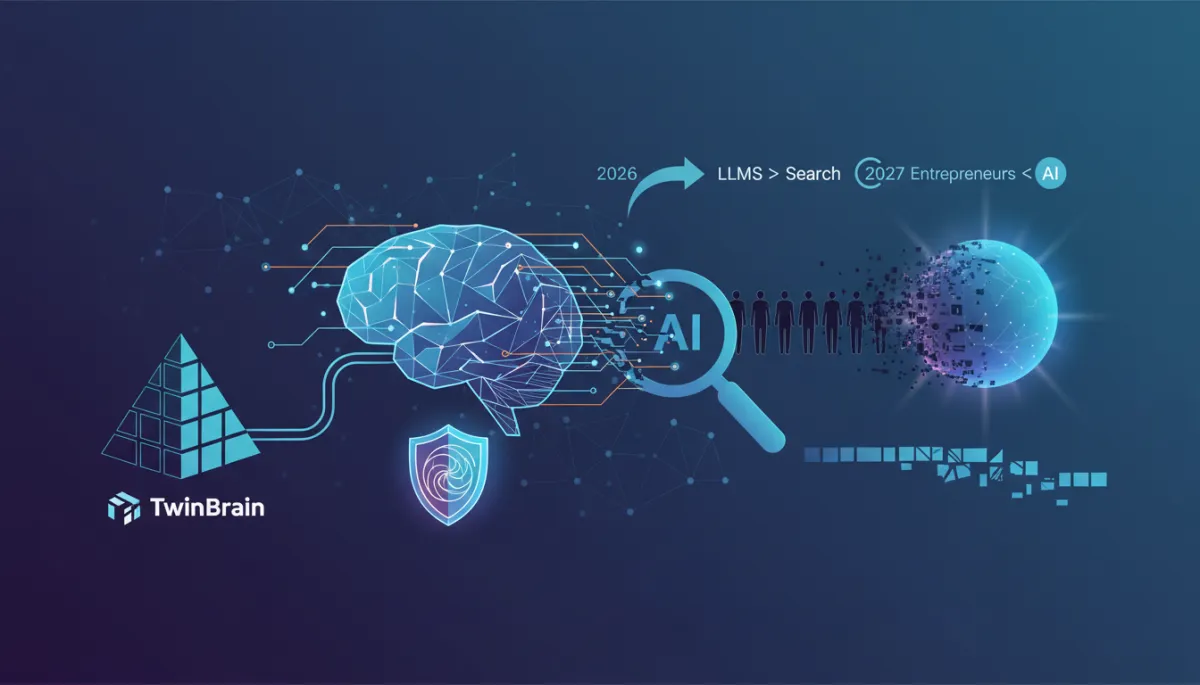
AI Search: The End of Entrepreneurs by 2027
AI Search, Entrepreneurship, SEO Disruption
Why AI Search Will Erase Most Entrepreneurs by 2027 (And How to Avoid Being One)
A silent deadline is approaching. As AI-native search engines replace traditional Google-style results, the playbook that built millions of online businesses is collapsing. Entrepreneurs who don’t control their own “intelligence layer” will simply vanish from the discovery ecosystem. This isn’t a distant future—it’s a 24‑month problem.
Traditional SEO Is Dying Faster Than You Think
For two decades, SEO was the growth engine: publish content, rank on Google, harvest inbound traffic. That system depends on a simple assumption—users type keywords, get a list of blue links, and click through to your site.
AI search breaks that assumption. Large language models (LLMs) don’t send people to ten blue links; they answer inside the interface. Forbes and Gartner both point to 2026 as the tipping point where AI‑driven, context‑aware search becomes the default experience, not the novelty (Forbes Tech Council, 2023; Gartner, 2023). When that happens, ranking on page one matters far less than being cited inside the AI’s answer.
Voice, visual, and multimodal search accelerate this shift. Users ask full questions, show images, or speak casually—and the AI responds with synthesized insights, not a directory of websites. Every percentage point of traffic that moves into AI chat is a percentage point you never see on your analytics dashboard.
By Mid‑2026, LLMs Will Dominate Inbound Discovery
Look at how search is evolving:
LLMs already understand natural language queries better than keyword engines, handling nuance, follow‑ups, and context across sessions.
They integrate text, images, and soon AR, creating multimodal search that feels like talking to a domain expert, not a database (TechRepublic, 2023; Wired, 2026).
Most critically, they can generate answers directly, collapsing the entire funnel from “search” to “solution” into a single interaction.
As these models become embedded in browsers, devices, and assistants, a growing share of “search moments” will never touch a traditional results page. By mid‑2026, it’s entirely plausible that LLM‑mediated queries will surpass classic search as the primary source of inbound discovery for many information‑driven businesses. If your strategy assumes “people will Google us,” you’re optimizing for a shrinking universe.
Generic AI Content Is Quietly Destroying Trust
At the same time, the web is being flooded with generic AI‑written articles that all sound the same: safe, polished, and empty. When everything reads like it came from the same model, audiences instinctively stop trusting what they see. They skim, they bounce, they assume it’s derivative—because most of it is.
This erosion of trust hits entrepreneurs hardest. Your advantage was never “having content”; it was having a distinct mind—your judgment, your pattern recognition, your lived experience. If your output is indistinguishable from a million other AI‑generated posts, you’ve surrendered the only thing that made your brand defensible.

In a web of sameness, authority shifts to the few voices that remain distinct.
Cognitive Sovereignty: Your New Competitive Moat
The entrepreneurs who survive this transition will practice cognitive sovereignty—the ability to own, encode, and deploy their own way of thinking at scale. Instead of outsourcing their brain to generic models, they’ll use tools that replicate their reasoning patterns, not just their writing style.
Cognitive sovereignty means:
Your frameworks, not just your phrases, are captured and reusable.
Your AI outputs make decisions like you, not like a statistical average of the internet.
You can scale your judgment across content, offers, and products without diluting your voice.
💡 Pro Tip: If your AI assistant can’t reliably answer “What would I say about this?” with depth and nuance, you don’t yet own your cognitive layer.
How TwinBrain Preserves Your Voice and Scales Your Authority
TwinBrain is built around this exact problem. Instead of treating your content as a pile of documents, it treats it as a map of how you think. It constructs knowledge graphs from your cognitive patterns—the way you connect ideas, weigh trade‑offs, and structure arguments—then uses that map to guide generation and decision‑making.
Practically, that means:
Your “AI twin” doesn’t just mirror your tone; it mirrors your logic and priorities.
Content, offers, and answers generated through TwinBrain stay recognizably you, even at scale.
Over time, the system becomes a living knowledge graph of your expertise that AI search engines can crawl, reference, and cite.
In a world where LLMs assemble answers from many sources, being represented as a coherent, high‑signal graph of ideas is how your work surfaces repeatedly in AI‑generated responses—long after generic SEO content has disappeared into the noise.
From Clicks to Citations: The New Success Metric
Traditional SEO optimizes for clicks: impressions, CTR, sessions. But in an AI‑first search world, many users will never click anything. Their entire interaction happens inside the model’s interface. That doesn’t mean your work is irrelevant—it means your metric is wrong.
The new currency is citations:
How often does an AI system draw from your knowledge graph to answer user questions?
How frequently are your frameworks, concepts, and phrases referenced or echoed in AI‑generated outputs?
When users ask follow‑up questions, does the AI continue to lean on your way of thinking?
TwinBrain is designed for this shift. By structuring your expertise into a machine‑readable, high‑signal graph, it makes your work attractive for AI systems to cite. You’re no longer just fighting for position on a results page—you’re competing to become part of the model’s internal library of trusted authorities.
Own Your Intelligence Layer—or Get Erased
Here is the uncomfortable truth: by 2027, many entrepreneurs won’t be “failing” in the traditional sense. They’ll simply stop being discoverable. AI search will still answer questions in their niche. It just won’t need them to do it.
To avoid being one of them, you need to:
Stop relying on legacy SEO as your primary growth strategy.
Invest in tools that capture and replicate your cognition, not just your copy.
Structure your expertise so AI systems can reference and cite it reliably.
That is what it means to own your intelligence layer. You’re not just publishing content into the void; you’re building an enduring, machine‑readable representation of your mind that can survive platform shifts, algorithm changes, and the rise of AI search itself.
📌 Key Takeaway: The era of ranking for keywords is ending. The era of being woven into the reasoning fabric of AI systems has begun. Entrepreneurs who move their intelligence into tools like TwinBrain now will be the ones AI still talks about in 2027.